Showing posts with label Surgery. Show all posts
Showing posts with label Surgery. Show all posts
Medicine is the science and art (ars medicina) of healing humans
Medicine
is the science and art (ars medicina) of healing humans. It includes a variety of health care practices evolved to maintain and restore health by the prevention and treatment of illness. Before scientific medicine, healing arts were practiced along with "Eastern medicine" — which are typically based in traditional, story-told, or otherwise non-scientific practices.
Contemporary medicine applies health science, biomedical research, and medical technology to diagnose and treat injury and disease, typically through medication, surgery, or some other form of therapy. The word medicine is derived from the Latin ars medicina, meaning the art of healing.
Though medical technology and clinical expertise are pivotal to contemporary medicine, successful face-to-face relief of actual suffering continues to require the application of ordinary human feeling and compassion, known in English as bedside manner.

vitello-intestinal remanents

Vitello-intestinal duct or omphalo-mesenteric duct connects the midgut to the yolk sac during early embryonic life. It gets obliterated and disappears during fifth to sixth week of intrauterine life.If the remnants persists then following abnormalities can occur:
Appendicectomy : Types, Indications, Steps, Postoperative care and Complications
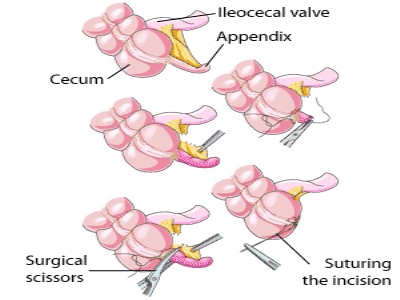
Appendicectomy may be performed by conventional open operation or by using laparoscopic techniques. The first surgeon to perform deliberate appendicectomy for acute appendicitis was Lawson Tam, in May 1880. The patient recovered. It is recorded in 1736 that Claudius Amyand successfully removed an acutely inflamed appendix from the hernial sac of a boy.
Physiologic Anatomy of Biliary Secretion
Physiologic Anatomy of
Biliary Secretion
Bile is secreted in two stages by the liver:
(1) The initial portion is secreted by the principal functional cells of
the liver, the hepatocytes; this initial secretion contains large amounts of bile acids, cholesterol, and other
organic constituents. It is secreted into minute bile canaliculi that originate between the hepatic cells.
(2) Next, the bile flows in the canaliculi toward the interlobular septa, where the canaliculi empty into terminal
bile ducts and then into progressively larger ducts, finally reaching the hepatic duct and common
bile duct. From these the bile either empties directly into the duodenum or is diverted for minutes up to
several hours through the cystic duct into the gallbladder
Gallstones
What are gallstones?
 Gallstones are small, pebble-like substances that develop in the gallbladder. The gallbladder is a small, pear-shaped sac located below your liver in the right upper abdomen. Gallstones form when liquid stored in the gallbladder hardens into pieces of stone-like material. The liquid—called bile—helps the body digest fats. Bile is made in the liver, then stored in the gallbladder until the body needs it. The gallbladder contracts and pushes the bile into a tube—called the common bile duct—that carries it to the small intestine, where it helps with digestion.
Bile contains water, cholesterol, fats, bile salts, proteins, and bilirubin—a waste product. Bile salts break up fat, and bilirubin gives bile and stool a yellowish-brown color. If the liquid bile contains too much cholesterol, bile salts, or bilirubin, it can harden into gallstones.
Gastrectomy
Gastrectomy is surgery to remove part or all of the stomach.
Description
The surgery is done while you are under general anesthesia (asleep and pain-free). The surgeon makes a cut in the abdomen and removes all or part of the stomach, depending on the reason for the operation.
 Depending on what part of the stomach was removed, the intestine may need to be re-connected to the remaining stomach (partial gastrectomy) or to the esophagus (total gastrectomy).
 Depending on what part of the stomach was removed, the intestine may need to be re-connected to the remaining stomach (partial gastrectomy) or to the esophagus (total gastrectomy).
Why the Procedure is Performed
Gastrectomy is used to treat bleeding, inflammation, non-cancerous tumors, or cancer.
peptic ulcer at aglance
 Can occur:
o In esophagus.
o In jejunum in Zollinger-Ellison syndrome (↑ Gastrin à HCl).
o After gastroenterostomy.
o In Meckel’s diverticulum (contains ectopic gastric mucosa).

Subscribe to:
Posts (Atom)


